
Flooded Twice in Two Years: The $150,000 Lesson for Commercial Insurance
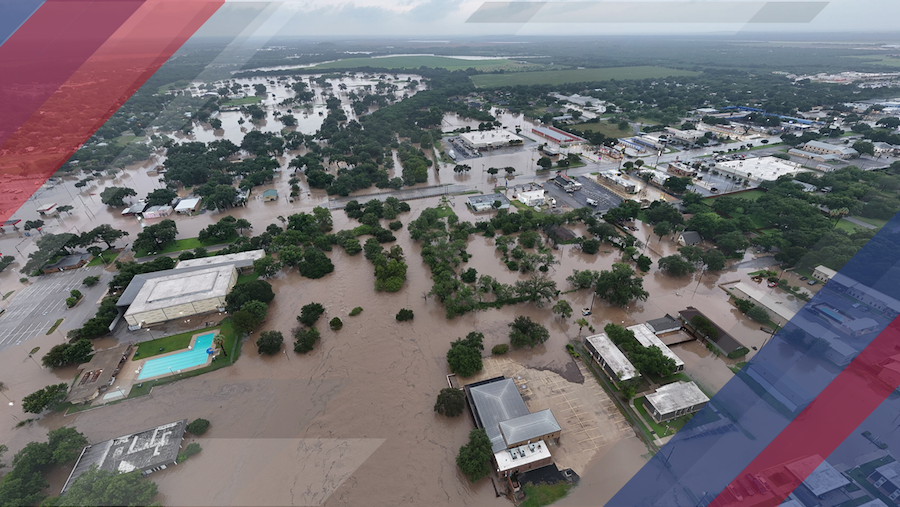
For dozens of Kerr County business owners, the July 2026 flood was not simply another weather event. It was a second financial emergency arriving before the first recovery was complete.
Approximately 100 businesses across the Texas Hill Country county suffered flood damage, including locally owned stores, service companies and community institutions that were still rebuilding after the catastrophic flooding of July 2025.
The losses illustrate how quickly a few inches of water can turn into damaged inventory, ruined equipment, structural repairs, employee disruptions and weeks of lost revenue. They also expose one of the most persistent misunderstandings agents encounter: being outside a mapped high-risk flood zone does not mean a business is outside the reach of floodwater.
A Second Flood Before Recovery Was Finished
After the 2025 flood, the parking lot at Gibson’s Discount Center became a gathering place for volunteers, meals and cleanup supplies. The store itself escaped major damage and helped support the surrounding community.
One year later, the business was among those needing help. Floodwater entered through an opening left when rushing water tore away an air-conditioning unit. Shelves were carried outside to dry, merchandise was discarded and employees began another uncertain recovery process.
The story was repeated across Kerrville. A sporting goods store took in several inches of water. A dance and cheer studio flooded for the second consecutive year. Powell Vacuum and Allergy, a locally owned sales and repair shop, sustained damage to merchandise, machinery and other business property.
Its owner estimated approximately $75,000 in damaged merchandise and equipment, followed by a similar potential loss from interrupted operations. That distinction matters. The water caused one category of loss, but the time required to clean, repair, reorder inventory and restore customer traffic created another.
“That was a 100-year flood; I’m out of the 100-year floodplain.”
The Map Was Never a Guarantee
The phrase “100-year flood” is widely misunderstood. It does not mean a flood of that size will occur only once every century. It describes an estimated 1% probability of that level of flooding in any given year. Multiple significant floods can occur within a short period, as Kerr County has now experienced.
Flood maps remain important tools for underwriting, community planning, lender requirements and risk communication. They are not, however, precise predictions of where the next loss will stop. Rainfall intensity, drainage capacity, changing development, debris, elevation differences and water moving from smaller creeks or paved areas can all affect an individual property.
Federal flood data shows that nearly one-third of National Flood Insurance Program claims from 2014 through 2024 originated outside areas currently classified as high risk. The practical lesson for agents is straightforward: a lower-risk designation should begin a conversation about price and probability, not end the conversation about coverage.
“Floods can happen anywhere, even in areas with low-to-moderate flood risk.”
One Flood Can Produce Several Different Losses
Business owners often think of flood damage as a single expense. In practice, the financial impact can spread across several policies, coverage limitations and operating decisions.
Building Damage
Water can damage walls, flooring, electrical systems, heating and cooling equipment, plumbing, doors and foundations. Even shallow water may require professional drying, mold remediation and environmental testing before employees or customers can safely return.
A tenant may assume the building owner will handle the problem, but the lease can assign responsibility for interior improvements, fixtures, maintenance or certain repair costs. Agents should understand both the insurance program and the lease obligations before determining where an exposure belongs.
Inventory and Equipment
Retailers can lose merchandise stored only a few inches above the floor. Service businesses may lose diagnostic tools, computers, machinery and customer property. Restaurants can face spoiled food, contaminated supplies and equipment that appears functional but cannot safely be returned to service.
Inventory values also change throughout the year. A limit that appears adequate during a slow month may be insufficient after a major seasonal shipment arrives. Coverage discussions should reflect peak values, not simply the amount visible during the most recent review.
Income and Extra Expense
The physical cleanup is only part of the financial problem. A business may remain closed while repairs are completed, utilities are restored, damaged stock is replaced or inspections are performed. Customers may also avoid the broader area long after the water recedes.
Standard business-income coverage generally depends on physical damage caused by a covered peril. Because flood is commonly excluded from standard commercial property forms, the associated income loss may also be excluded unless the insurance program specifically addresses it.
National Flood Insurance Program commercial coverage is designed primarily for direct physical flood damage. It can provide up to $500,000 for an eligible nonresidential building and a separate limit of up to $500,000 for contents, but it is not a complete business-interruption solution. Depending on the client’s needs, private flood coverage or other specialized options may be necessary to address higher property values and income exposures.
Access and Community Disruption
A business does not need water inside its building to suffer a serious loss. Closed roads, damaged bridges, utility failures and restricted access can prevent employees, customers and suppliers from reaching the premises.
Coverage for civil authority, dependent properties, utility interruptions and ingress or egress varies considerably. The triggering event, distance requirements, waiting periods and duration of coverage can all affect whether a claim responds. These details should be reviewed before a disaster, not interpreted for the first time while revenue is disappearing.
Disaster Assistance Is Help, Not an Insurance Strategy
Community organizations and nonprofit lenders have moved quickly to assist Kerr County businesses. One local recovery program offered qualifying businesses grants of up to $10,000, an important source of immediate support for cleanup and minor repairs.
For an owner facing approximately $150,000 in combined physical damage and lost business, however, a $10,000 grant covers only a fraction of the need.
Federal disaster programs may provide additional assistance after qualifying declarations. The Small Business Administration can offer low-interest loans for physical damage and operating expenses that insurance or other funding does not cover. Those funds can be valuable, but they remain loans that generally must be repaid.
Availability also depends on declarations, eligibility requirements, documentation and application timelines. Not every flood receives the necessary federal designation, and assistance may not arrive quickly enough to solve an immediate payroll, rent or supplier obligation.
Insurance provides a prearranged method of transferring defined risks. Disaster assistance is a recovery resource that becomes available only after certain conditions are met. Treating the two as substitutes can leave a business owner depending on uncertain funding at the moment cash is most urgently needed.
The Commercial-Lines Conversation Agents Should Have
The strongest flood review moves beyond asking whether the building appears inside a high-risk zone. It examines how water could reach the location, what would be damaged and how long the business could operate without normal access or revenue.
- Challenge the map assumption: Explain that lower mapped risk does not mean zero risk.
- Separate property values: Review the building, improvements, equipment, inventory and customer property individually.
- Calculate income exposure: Estimate continuing expenses and realistic restoration time after a regional disaster.
- Examine dependencies: Identify critical roads, utilities, suppliers, landlords and neighboring properties.
- Compare flood options: Evaluate NFIP and private-market terms, limits, deductibles, exclusions and waiting periods.
- Document the decision: Record coverage recommendations, client responses and any decision to decline protection.
This approach turns a general warning about floods into a financial discussion grounded in the client’s actual operation. A store owner may not respond to a flood-zone designation, but that same owner may pay attention when shown how much inventory is stored below three feet, how many weeks of payroll must continue and how little cash is available for an emergency.
What Agencies and Carriers Can Learn
For agencies, Kerr County is a reminder that flood coverage should not be treated as a coastal specialty or a lender-driven transaction. Inland businesses near rivers, creeks, drainage channels and rapidly developing areas may face significant exposure even when coverage is optional.
Proactive outreach can also strengthen client relationships. A targeted review of businesses located near prior flood events, low-water crossings or known drainage problems gives producers a practical reason to contact clients between renewals. The goal is not to frighten owners. It is to replace a vague sense of safety with a realistic understanding of what the map does and does not communicate.
For carriers and program administrators, repeated events demonstrate the importance of property-level information. Elevation, first-floor height, construction, drainage, equipment placement, prior water intrusion and surrounding development may provide a fuller picture than a flood-zone letter alone.
Carriers can also improve outcomes by helping policyholders understand documentation expectations before a loss. Current inventory records, photographs, equipment schedules, lease documents, financial statements and continuity plans can reduce confusion and support faster claim evaluation.
Mitigation Can Protect Both Property and Cash Flow
Insurance is only one part of flood resilience. Businesses that have experienced repeated water intrusion may need to reconsider how the premises are arranged and how quickly essential operations can be moved.
Practical measures may include raising merchandise and electrical equipment, relocating critical records, improving drainage, installing flood-resistant materials, using temporary barriers and storing replacement data away from the premises. Property owners may need professional engineering advice before modifying walls, entrances or mechanical systems.
Continuity planning matters just as much. Businesses should know how employees will communicate, where temporary operations could be established, which suppliers can provide emergency replacements and how customers will receive updates. Even a modest plan can shorten the period between physical cleanup and restored revenue.
Agents should avoid suggesting that a mitigation measure automatically guarantees coverage or lowers premiums. Instead, they can help clients document improvements and present updated information to the insurer for proper evaluation.
The Real Risk Is the Gap Between Perception and Reality
The Kerr County businesses now cleaning shelves, replacing equipment and trying to bring customers back are not abstract examples on a flood map. They are employers, local institutions and family-owned operations whose financial reserves were already weakened by the previous year’s disaster.
Their experience gives insurance professionals a useful way to reframe the flood discussion. The question is not simply whether a lender requires coverage or whether a property sits inside a particular shaded area. The question is whether the business could survive damaged property, interrupted revenue and delayed assistance at the same time.
For many small businesses, the answer depends on decisions made months or years before the water arrives. A thoughtful coverage review, realistic income calculation and practical recovery plan may not prevent the next flood, but they can determine whether the doors eventually reopen.