
Massive Tree Smashes House as Insurance and Neighbors Help a Family Rebuild
When Insurance Rebuilds the House and a Community Helps Rebuild a Family’s Life
A tree can destroy part of a home in seconds, but restoring a family’s sense of stability requires much more than repairing walls and replacing a roof.
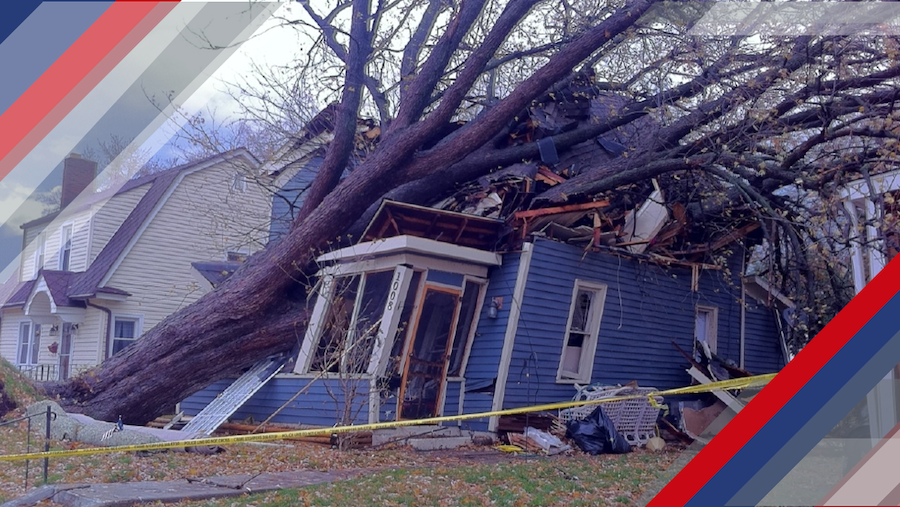
That distinction became clear in New Fairfield, Connecticut, after a massive tree crashed through a home shared by the Istvan and Rywolt families during severe Fourth of July thunderstorms. Three family members were inside when the tree struck. Everyone survived, but the main portion of the house became unsafe to occupy.
The Rywolt household, which includes two adults and four children, suddenly needed somewhere else to live. The Istvan family was able to remain in an unaffected apartment portion of the property, but both families were left facing the disruption, uncertainty and practical demands that follow a major property loss.
Homeowners insurance was expected to fund the structural repairs. At the same time, friends and neighbors organized a fundraiser to help with temporary housing, food, clothing, personal belongings and other immediate expenses. By the time the local story was published, the campaign had raised $9,800 toward a $16,000 goal. :contentReference[oaicite:0]{index=0}
“By the grace of God, everyone survived, but the home has been left unlivable.”
Casi Newgent, fundraiser organizer
The Most Important Part of the Story Is the Space Between Loss and Recovery
From an insurance perspective, the most visible part of this loss is the damaged structure. A tree penetrated the home, significant repairs are required and the property must be made safe before the displaced family can return.
For the family, however, the first questions are often more immediate. Where will everyone sleep tonight? What clothing, medications, school supplies and personal items can be recovered? Is there a temporary rental large enough for the household? Can the family remain near work, school, child care and established medical providers?
These questions reveal why a property claim is never only about property. The physical damage may activate the policy, but the disruption affects nearly every part of a household’s daily routine.
Insurance and community assistance are not competing solutions in this situation. They serve different functions and often operate on different timelines. Insurance provides the financial framework for restoring covered property and reimbursing eligible expenses. Community support can provide flexibility, speed and help with needs that may fall outside coverage, exceed limits or arise before reimbursement is available.
Additional Living Expenses Can Be One of the Most Valuable Parts of a Home Policy
Most homeowners policies include some form of loss-of-use or additional living expense coverage when a covered loss makes the residence uninhabitable. Depending on the policy, that coverage may help with temporary housing, additional meal expenses and other necessary increases in the household’s cost of living.
The key word is additional. The coverage generally addresses the difference between the household’s normal expenses and the higher expenses caused by displacement. It does not usually replace every ordinary household bill. A homeowner may still be responsible for the mortgage, utilities that remain active and other costs that existed before the loss.
Coverage can also be subject to a dollar limit, a time limit or both. The National Association of Insurance Commissioners advises consumers to ask their insurer, agent or adjuster how the coverage works and what restrictions apply. :contentReference[oaicite:1]{index=1}
“Keep all receipts for any additional costs you have.”
National Association of Insurance Commissioners
That advice sounds simple until a family is standing outside a damaged home trying to arrange lodging, feed several children and determine which belongings can be safely retrieved. Receipts are easily lost, expenses become mixed together and verbal conversations with contractors, adjusters and temporary-housing providers can be difficult to reconstruct later.
This is where proactive agency guidance can make a measurable difference.
Why Immediate Needs May Still Require Outside Help
The existence of additional living expense coverage does not mean every expense will be paid immediately. Some policies reimburse policyholders after documentation is submitted. Others may permit advances, direct billing arrangements or insurer-supported temporary housing.
There may also be uncertainty during the first days of the claim. The family may not yet know how long the property will be uninhabitable, whether a particular rental is considered reasonable or which expenses will qualify for reimbursement.
A family of six can face additional challenges. A standard hotel room may not be practical. A suitable short-term rental may require a deposit, pet fee or minimum lease commitment. Restaurant costs may increase if temporary lodging does not include a kitchen. Longer commutes can add fuel, toll and transportation expenses.
Personal property creates another layer of complexity. Some items may be damaged, inaccessible or contaminated by rain, insulation, broken building materials or other debris. Even when those belongings are covered, the household may need essential replacements before a full inventory can be completed and evaluated.
Community donations can provide money for those transitional needs without waiting for the claims process to determine whether each expense is covered. That does not indicate that insurance has failed. It reflects the reality that a policy is a contract with defined terms, while disaster recovery is a human process filled with urgent and unpredictable needs.
The Agent’s Role Begins Long Before the Tree Falls
Many homeowners understand that insurance protects the building, but fewer can explain how their policy would support them if the home became temporarily unlivable. A renewal conversation that focuses only on the dwelling limit, premium and deductible may leave one of the policy’s most useful features unexplored.
Agents can make loss-of-use coverage more tangible by asking clients to imagine a realistic displacement scenario. Where would a family of five or six live? Does the household have pets? Is anyone working from home? Would temporary housing need to be near a particular school, employer or medical facility?
Those questions can reveal whether the available limit appears appropriate for the household’s actual circumstances. They also help clients understand that temporary housing costs can become significant when repairs take months rather than weeks.
Agents should avoid promising that a particular expense will be covered without reviewing the policy and circumstances. They can, however, explain the purpose of the coverage, identify applicable limits and encourage clients to contact the carrier immediately after a loss.
A Practical Preparedness Conversation
A brief review before storm season or at renewal can help clients prepare for the first hours after a major property loss:
- Confirm the limit: Review loss-of-use dollars, percentages and time restrictions.
- Build an inventory: Photograph rooms, closets, electronics and valuable personal belongings.
- Store records safely: Keep policy information and inventories in secure digital storage.
- Document the damage: Photograph conditions before debris removal or temporary repairs begin.
- Track every expense: Save receipts for lodging, meals, transportation and emergency purchases.
Home inventories can be especially valuable when a claim involves a large number of personal belongings. Photographs, purchase records and digital receipts may help establish ownership and value when items are destroyed or inaccessible. Insurers also commonly expect policyholders to take reasonable temporary measures to prevent additional damage, while documenting conditions before those measures are completed. :contentReference[oaicite:2]{index=2}
Shared Homes Can Create Additional Questions
The New Fairfield property was occupied by two families living in different portions of the same home. The publicly available account does not describe the policy structure, so no conclusions should be drawn about how the specific claim was arranged.
The situation nevertheless raises useful questions for agents working with multifamily homes, accessory apartments, multigenerational households and shared ownership arrangements.
Who owns the building? Which household occupies each portion? Are all residents correctly identified? Does a separate household need renters coverage for its belongings and additional living expenses? Has the property been modified since the policy was written?
These details can change over time as adult children return home, parents move in, apartments are added or relatives begin sharing expenses. An annual occupancy review can help ensure that the policy reflects how the property is actually being used.
Carriers Have an Opportunity to Reduce the Stress Between Coverage and Reimbursement
For carriers, losses like this demonstrate why the early claims experience matters so much. A family may ultimately receive all covered benefits owed under the policy and still remember the claim as difficult if the first several days were confusing.
Clear explanations can reduce that uncertainty. Policyholders need to understand what expenses can be submitted, whether advance payments are available, how temporary housing is selected and who to contact when circumstances change.
Claims teams can also recognize that the least expensive temporary option is not always the most practical. A household with four children may need more space than a couple. A family with pets may have fewer rental choices. School transportation and commuting distance may affect whether a property is reasonably suitable.
Empathy does not require expanding coverage beyond the contract. It means administering the coverage clearly, promptly and with an understanding of the disruption the policyholder is experiencing.
Community Support Does Not Diminish the Value of Insurance
The fundraiser for the Istvan and Rywolt families reflects something positive about both the community and the role of insurance.
The policy is expected to support the expensive work of repairing the home. Friends and neighbors are helping with the immediate, personal and unpredictable costs of displacement. Together, those resources give the families a stronger recovery foundation than either could provide alone.
For agents and carriers, the lesson is not simply that homeowners need adequate dwelling coverage. They need a recovery plan that accounts for the people who live inside the dwelling.
A productive coverage conversation should therefore extend beyond rebuilding costs. It should address temporary housing, household size, documentation, personal property, changing occupancy and the practical steps a client should take during the first hours after a loss.
The New Fairfield families survived an event that could have ended very differently. Insurance can help rebuild what the storm damaged. The community’s response can help preserve stability, dignity and connection while that rebuilding takes place.