
DOJ Secures Record 6.8 Billion in Healthcare Fraud Settlements for FY 2025
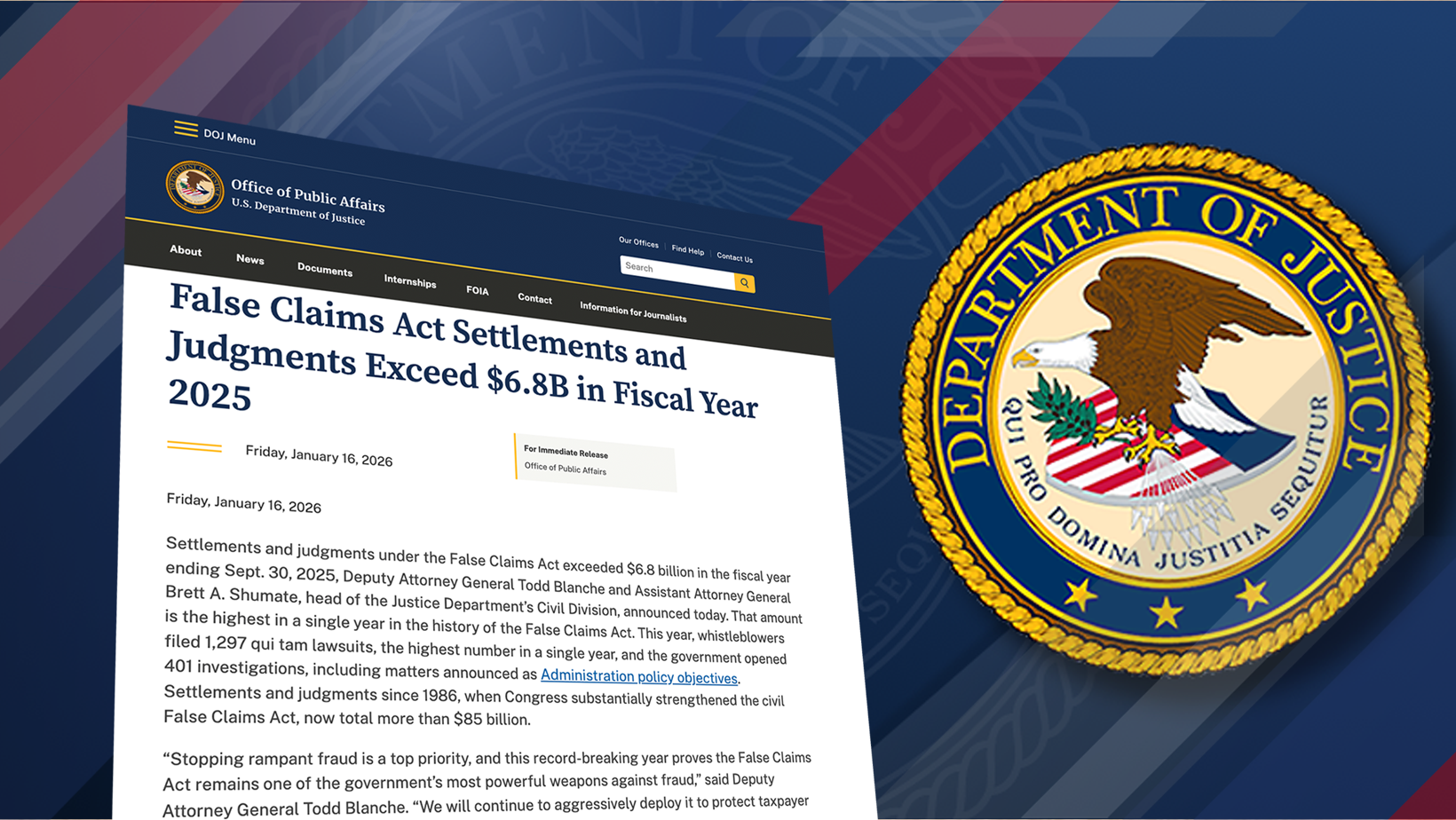
DOJ’s $6.8B False Claims Act Year: What It Signals for Insurers, Agencies, and Healthcare Risk
Fiscal year 2025 delivered a headline the insurance industry should not ignore: the Department of Justice secured more than $6.8 billion in False Claims Act settlements and judgments, with the majority tied to healthcare-related conduct. That number is not just a government scoreboard. It is a market signal, and it affects underwriting, distribution strategy, claims scrutiny, compliance expectations, and executive risk conversations across the carrier and agency ecosystem.
For insurers, the takeaway is straightforward: enforcement intensity is shaping operational risk in healthcare and adjacent sectors, and the ripple effects will show up in submissions, policy language discussions, and renewal negotiations. For agencies, it is a chance to lead with proactive guidance and a tighter risk narrative, especially for clients that touch government reimbursement, managed care, or digital health.
Why the False Claims Act Matters to Insurance
The False Claims Act is often framed as a healthcare compliance issue, but it is also a driver of loss trends. When enforcement expands, it changes how organizations document decisions, manage vendors, support pricing and coding, and respond to internal exceptions. Small process gaps can become multi-year investigations with significant defense spend, board exposure, and reputational fallout.
From an insurance perspective, FCA exposure rarely stays in one lane. It can create pressure across multiple lines at once, especially when allegations center on what the organization said, what it billed, what it documented, and what it can prove.
“When enforcement priorities shift, yesterday’s routine workflow becomes today’s governance question.”
— Jordan Lee, Healthcare Risk Practice Leader
How FCA Exposure Shows Up Across Coverage
FCA activity influences underwriting and claims decisions because it raises two core issues: intent and evidence. Investigators look for patterns, decision trails, and repeatable controls. Underwriters and claims teams look for the same things, just earlier in the timeline.
It also matters that many FCA matters begin with whistleblowers. Qui tam actions can accelerate timelines, widen allegations, and trigger early defense costs before an organization has clarity on what the government will ultimately pursue.
Healthcare Remains the Center of Gravity
The most consistent enforcement themes continue to sit at the intersection of patient care, payer rules, and financial incentives. In practical terms, that means scrutiny around marketing practices, reimbursement support, coding and documentation, and remuneration arrangements that can influence referral patterns or treatment choices.
Medicare Advantage remains especially important because it is large, complex, and data-driven. For carriers and agencies serving this space, the trend reinforces a need for defensible operational controls. The question is not whether an organization has a compliance program on paper. The question is whether it can demonstrate consistent execution, especially when financial outcomes could be interpreted as incentive-aligned.
A Familiar Enforcement Pattern
Many large matters follow a repeatable storyline: utilization stands out, documentation is challenged, and leadership decisions become evidence. Once that loop starts, the risk is rarely limited to a single allegation. It can broaden into questions about training, supervision, vendor management, and what the organization knew when performance improved or anomalies appeared.
Cybersecurity and Digital Health Are Now Part of the FCA Conversation
A notable evolution is the DOJ’s willingness to pursue FCA theories tied to technology controls, cybersecurity representations, and digital health workflows, particularly where government funds, government contracts, or government program requirements are involved. This matters because many organizations rely on vendor platforms, AI-assisted decisioning, and outsourced services that shape documentation and payment integrity.
For insurers, this is not only a cyber story. It is a misrepresentation story. If an organization attests to security controls, data handling practices, or audit readiness and cannot support those statements under pressure, FCA-style allegations can overlap with breach response costs, regulatory inquiries, and contractual disputes.
“In a digital-first healthcare environment, compliance is what your systems can prove, not what your policies promise.”
— Priya Patel, Chief Compliance Officer, Digital Health Services
Why Utilization Management and AI Workflows Raise the Stakes
Prior authorization and utilization management debates matter for risk transfer because algorithmic workflows can affect timeliness, documentation quality, and patient access. Even when the core issue is operational, the resulting allegation can be framed as a payment or representation problem if records are incomplete, exceptions are not governed, or vendor roles are unclear.
What to Expect in 2026 Renewals
These enforcement results will influence how underwriters evaluate healthcare accounts and adjacent sectors such as life sciences, revenue cycle vendors, digital health, and managed care contractors. Expect deeper questions about governance, auditability, and third-party oversight, along with greater sensitivity to growth narratives that depend on aggressive reimbursement strategies.
For agencies, this is a practical opening to strengthen the submission story. The best outcomes often come from anticipating enforcement-style questions and proactively showing how controls work in the real world, not just how they are described in a policy binder.
One Practical Checklist for Client Conversations
If you want one theme to guide these discussions, make it evidence. If a control exists, can it be demonstrated, repeated, and audited? That is increasingly the line between a manageable compliance issue and an enforcement-driven event that spills across multiple lines of coverage.
- Billing validation: How coding and documentation are reviewed, and how exceptions are handled.
- Marketing governance: Controls around referrals, inducements, and incentive-driven programs.
- Managed care readiness: Medicare Advantage data integrity, audit response, and escalation paths.
- Vendor map: Third parties touching claims, coding, prior auth, or patient communications.
- Cyber evidence: Security representations supported by proof, testing, and retained artifacts.
Bottom Line: A Risk Signal, Not Just a Legal Headline
A record-setting FCA year suggests enforcement will remain an active pressure point for healthcare, managed care, and the growing digital health ecosystem. Carriers should plan for more detailed underwriting conversations around reimbursement integrity, governance, and technology controls. Agencies can add real value by helping clients document what they do, why they do it, and how they monitor it, long before an external party asks.
In other words, compliance is no longer a back-office function. It is an operational proof story, and the insurance industry is increasingly part of how that story gets evaluated, priced, and protected.